

:fill(white)/92c70a1b8e7154e3a19a55521fa94b4d)
:fill(white)/e12bf1d3648f10db0a4244731c722be0)
:fill(white)/1dfabc0f7ab2dc066e1f0c70f4b0a46a)
:fill(white)/372ef676729f353aaeb96ac4cee58833)
:fill(white)/73721b860f84b7c674143931281e55bf)
:fill(white)/e4ea553aa3582c5a760d394d0427359b)
:fill(white)/5f70812dd9503d866b2f7d68b5759397)
:fill(white)/0a8936f2cf2120963d4f1120dda60af1)
:fill(white)/ff383e42004a965ffa17eda74fa1ba25)
:fill(white)/cee05c6cce9e072f84c75cf65e7232ae)
:fill(white)/b1e9142e7cd227963a0fea19b226466c)
Mirrors with anti-fog function – how do they work and are they worth it?
:fill(white)/400ce67dfd08469cf12bf2a39294a116)
In the bathroom, we start and end each day. Unfortunately, after a hot shower or bath, the mirror often becomes fogged up, making even simple tasks like shaving or applying makeup difficult. The solution to this problem is mirrors with an anti-fog function. How do they work and are they really worth the investment? Let’s find out.
Key information
- The anti-fog function works by heating the mirror surface, preventing water vapor from condensing.
- Mirrors with this function significantly improve daily bathroom comfort, save time, and make cleaning easier.
- Energy consumption of anti-fog mirrors is low.
- Heated mirrors require connection to the electrical installation.
- Anti-fog mirrors work best in small or poorly ventilated bathrooms.
- When choosing a heated mirror, it’s worth paying attention to the heating mat power, build quality, and protection rating.
How does the anti-fog function work in mirrors?
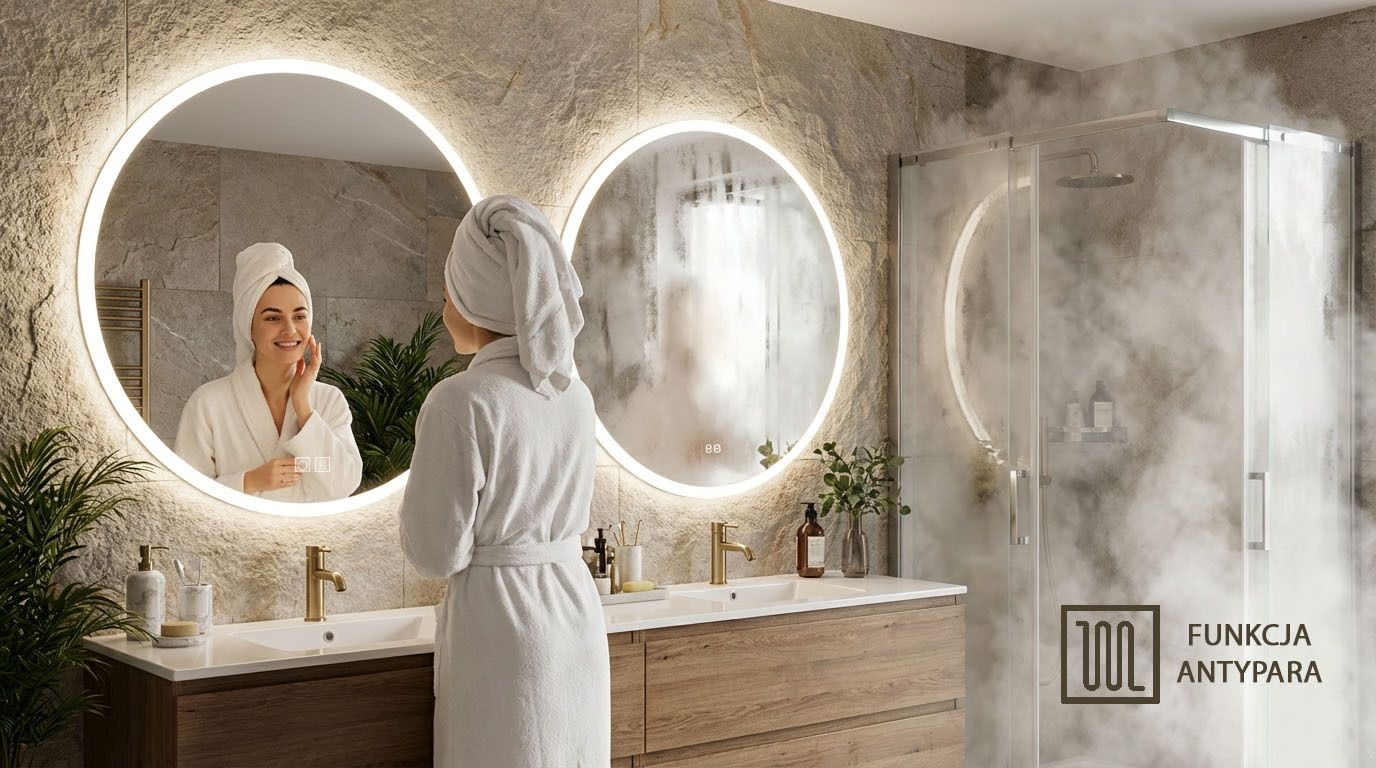
Mirrors with an anti-fog function use a surface heating system that prevents condensation.
How it works
- A heating mat or special heating film is located behind the mirror surface.
- When switched on, the mirror gently warms up, so its temperature is higher than the air in the bathroom.
- Water vapor does not settle on the surface – the mirror remains clear.
This is the same effect we see, for example, on a heated rear car window.
How is the anti-fog function activated?
Depending on the model, the function can be activated in several ways:
- a separate touch button on the mirror,
- automatic activation together with LED lighting,
- connection to the light switch,
- in more advanced models – a humidity sensor.
What are the advantages of mirrors with an anti-fog function?
At first glance, it may seem like a small convenience, but in practice it significantly improves daily bathroom use. It combines functionality with modern design and eliminates one of the most common problems in humid rooms.
Comfort of use
You no longer need to wipe the mirror with a towel after every shower. This is especially convenient in daily routines – the mirror is always ready to use.
Time saving
You can shave, get ready, or apply makeup immediately without waiting for the fog to disappear. A small change that greatly improves your daily routine.
Better hygiene
No need to touch the mirror surface means fewer smudges, streaks, and fingerprints. As a result, the mirror stays clean for longer.
Modern design and functionality
Most heated mirrors feature a minimalist design and additional functions such as touch control.
Disadvantages of anti-fog mirrors worth knowing
Like any solution, anti-fog mirrors also have some drawbacks:
- higher price – they are more expensive than standard models;
- energy consumption – although low, it still exists;
- installation – often requires connection to electricity.
Is it worth buying a mirror with an anti-fog function?
Yes – despite the higher initial cost, it is a worthwhile investment.
It’s especially worth considering if:
- you have a small or poorly ventilated bathroom;
- you frequently take hot showers or baths;
- you value comfort and modern solutions.
What should you consider when choosing an anti-fog mirror?
Choosing such a mirror is not only about aesthetics but also about matching the technology and parameters to real bathroom conditions.
Before purchasing, consider:
- heating mat power and surface – the larger the mirror, the more important the correct parameters;
- glass and coating quality – important for moisture resistance and durability;
- control method – suited to your habits;
- additional features – LED lighting or a clock increase comfort;
- size and proportions – adapted to the space;
- moisture resistance (IP) – crucial in bathrooms.
A well-chosen anti-fog mirror is a long-term investment that combines functionality and comfort.
Anti-fog mirrors – a solution that makes everyday life easier
Mirrors with an anti-fog function are a practical and increasingly popular solution that significantly improves bathroom comfort. Although they are more expensive than traditional models, their functionality fully justifies the cost.
FAQ
-
Does the anti-fog function work immediately after switching on?
Not always – it usually takes from a few dozen seconds to a few minutes.
-
Can an anti-fog mirror overheat?
No – high-quality models have thermal protection.
-
Does the anti-fog function work on the entire mirror surface?
It depends on the model – often only on the central area.
-
Can such a mirror be installed by yourself?
Yes, but professional assistance is often recommended.
-
Are anti-fog mirrors safe in bathrooms?
Yes, provided they have the appropriate protection rating and certifications.
-
Can the anti-fog function be used continuously?
Yes, but it’s best to use it only when needed.